
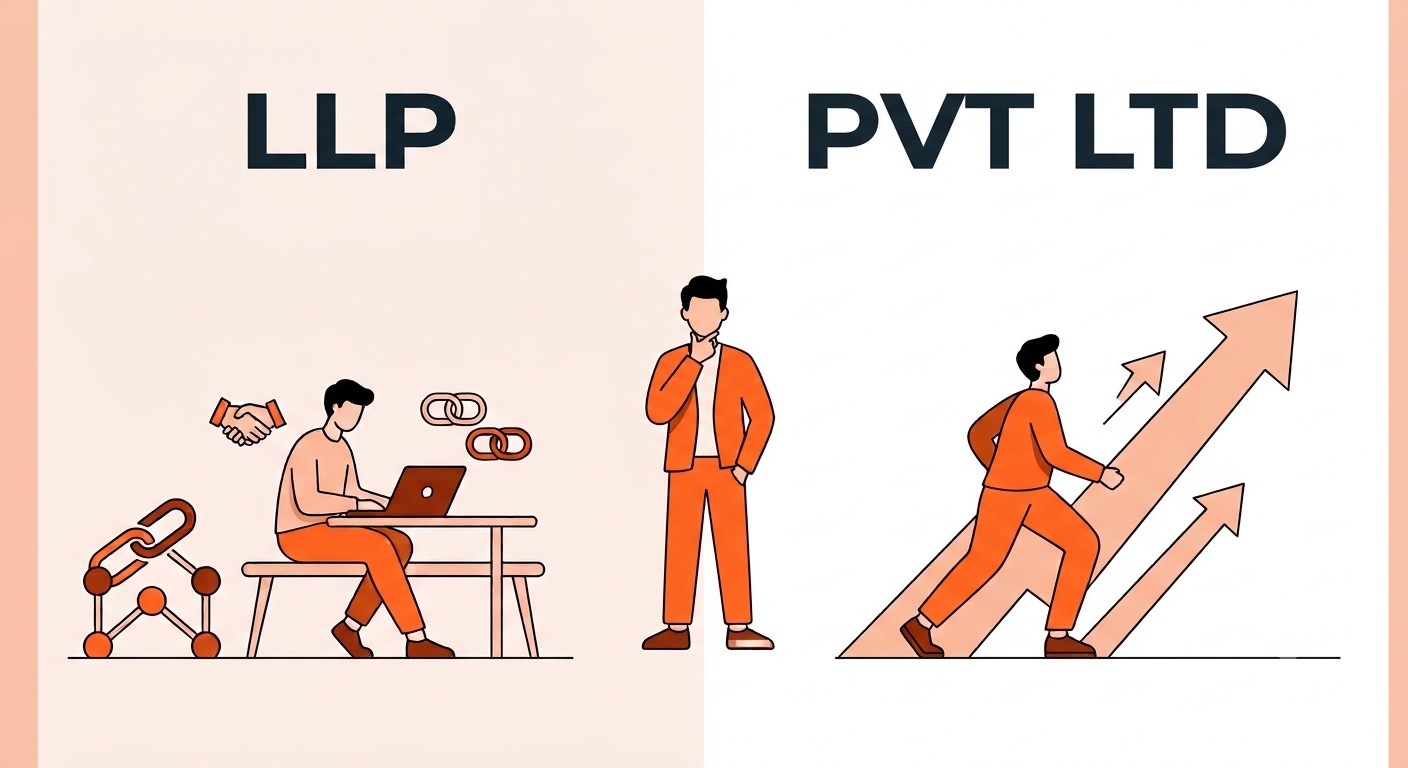
The Real Difference Between an LLP & a Private Limited Isn't What You Think
Almost every founder reaches this point sooner or later: LLP or Private Limited?
A quick Google search brings up the same comparison table. Liability, taxation, compliance and funding. It looks like everything you need to make a decision.
The comparison isn't wrong. It's just answering the wrong question.
Instead of asking, “What's the difference?”, ask yourself, “What will my business need 18 months from now?” The best business decisions aren't made for the company you have today. They're made for the company you're building.
“But It's Just the Two of Us… and a Shared Laptop.”
That's exactly why this decision often gets made too quickly.
When you're just starting out, an LLP naturally feels like the simpler option. It's cheaper to set up, involves fewer compliance requirements, and a Private Limited company can seem like something meant for “bigger” businesses.
Before you decide, ask yourself one question: Will this business ever need to give equity to someone outside the founding team?
That could mean an angel investor, a future co-founder, or a key employee through an ESOP. If the answer is yes, or even “probably yes,” a Private Limited company is usually the better choice. It gives you the flexibility to issue equity, raise investment, and grow without changing your legal structure later.
An LLP doesn't issue equity shares in the same way. If raising investment becomes part of your journey, you'll likely need to convert your business into a Private Limited company. That means additional time, cost and paperwork at a stage when your attention should be on growing the business, not restructuring it.
An LLP isn't a second-best option. For many businesses, it's the right one. If you're building a consultancy, professional practice or a closely held services business with no plans to raise external capital, an LLP is often the more practical choice. The lighter compliance isn't a compromise. It's exactly what the structure was designed for.
Think Beyond Today
Many founders choose an LLP simply because the compliance requirements are lighter. While that's true, lower compliance shouldn't be the deciding factor on its own. The additional governance that comes with a Private Limited company is also what makes it easier to attract investors, offer ESOPs and build credibility with larger clients and institutions.
Ultimately, the decision isn't about choosing the structure that's easiest today. It's about choosing the one that supports the business you're trying to build.
If you're still unsure, come back to one simple question: Will ownership ever need to extend beyond the founding team? If the answer is yes, a Private Limited company is likely to save you time and effort in the future. If the answer is no, an LLP may be exactly the right fit.
Further Reading
For readers who want to explore the legal definition in more detail, Startup India provides official guidance on different business structures.